What PushPress's Pricing Page Is Actually Telling You

If you've ever compared gym software, you've probably done some version of what every owner does: open a few vendor websites in separate tabs, screenshot the pricing pages, and compare the numbers. For vendors with straightforward, capacity-based pricing — Gymdesk at $75 to $200 per month depending on member count, GymMaster with a similar model — this works well enough. You can see the tiers, estimate where your gym lands, and arrive at a number within a few minutes.
PushPress fits right into that comparison at first glance. A free tier, a $159 plan, a $229 plan — clean pricing cards with published numbers, nothing that would raise a flag during a quick side-by-side scan. In my earlier post on how pricing pages signal product fit, I put PushPress in the third category: tiered with public pricing but unclear differentiation. That was the framework-level view. This post is what happens when you sit down with the actual numbers and work through what the page is telling you — and, in a few important places, what it isn't.
The free tier that isn't free
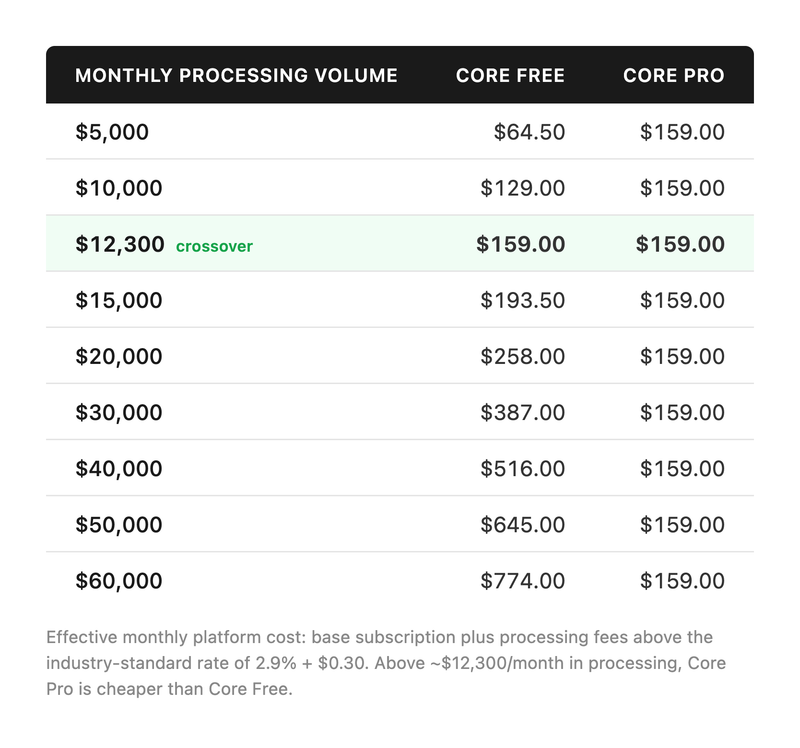
PushPress's Core Free plan carries no monthly subscription, which makes it genuinely appealing as a starting point — especially for an owner who's already overwhelmed by the cost of opening a gym and trying to minimize recurring expenses wherever possible. But the pricing doesn't stop at the subscription line. Core Free processes payments at 4.19% plus $0.30 per transaction, which is 1.29 percentage points above the industry-standard rate of 2.9% plus $0.30 that you'd get from most payment processors. That gap is where the actual cost lives, and unlike a flat subscription, it scales with your revenue.
To put a number on it: a gym processing $20,000 per month in member payments through Core Free is paying roughly $258 per month in processing costs above what a standard processor would charge. At $30,000 per month — a realistic figure for a gym with 150 to 200 members on recurring billing — that reaches $387. The plan is free in the sense that PushPress doesn't send you a separate subscription invoice, but the cost is embedded in every transaction, and it compounds faster than most owners expect.
The more useful way to think about this is the crossover point. Core Pro costs $159 per month and processes payments at the standard 2.9% plus $0.30 — no marginal cost above what you'd pay with any other processor. So the question isn't really "should I pay for software or use the free plan?" It's "at what processing volume does the free plan become more expensive than the paid one?" The answer is roughly $12,300 per month. Above that threshold, you're paying more to be on the free tier than you would on Core Pro. Below it, Core Free genuinely costs less. For most gyms with an established membership base, the paid plan is the better deal, which means the free tier functions less as a long-term operating plan and more as an onramp that grows increasingly expensive as your gym succeeds.
The tier nobody should buy
This is where PushPress's pricing structure gets genuinely interesting. Core Pro at $159 per month and Max at $229 per month sit side by side on the pricing page as distinct plans with distinct positioning. Core Pro is described as being for "mid-size gyms and studios ready to scale their business and optimize operations." Max is for "established gyms and studios ready to streamline operations and accelerate growth." If you stripped the tier names and shuffled the descriptions, you'd have no reliable way to match them back — mid-size and established, scale and accelerate, optimize and streamline. The language gestures at a meaningful difference without ever naming one.
That's because, functionally, there isn't one. I've gone through the two plans feature by feature using PushPress's own comparison checklist, and I cannot identify a single capability that exists in Max but not in Core Pro. The sole difference is the payment processing rate: Max charges 2.75% plus $0.30 per transaction instead of Core Pro's 2.9% plus $0.30 — a reduction of 0.15 percentage points. On the surface, that sounds like it could matter for a high-volume gym. So I sat down and ran the numbers.
To recoup the $70 per month price difference through processing savings alone, a gym would need to run approximately $46,700 per month through PushPress's payment system. That's a substantial operation — comfortably north of 200 active members at most pricing structures, and well into the upper range of what a single-location gym typically handles. At $30,000 per month in processing, the Max tier costs $184 in effective monthly fees compared to $159 for Core Pro — you're paying $25 more per month for the privilege of a rate reduction that hasn't caught up to the price increase. At $40,000, it's $169 versus $159. Max doesn't break even until the very top of single-location gym revenue, and even past that threshold, the monthly savings amount to single digits.
So what is this tier actually doing on the pricing page? I think it serves two purposes, and neither of them is being the plan most customers should choose.
The first is that it creates exactly the kind of uncertainty that leads a prospect to book a demo. When you're looking at two paid tiers with identical feature sets, interchangeable descriptions, and a pricing difference that doesn't obviously favor either one, the natural response is to want someone to explain the distinction. That's a sales call, and once you're on one, the conversation shifts to where PushPress's pricing structure actually gets interesting — the add-ons.
The second purpose is subtler, and it has to do with how the pricing page reads as a whole. On its own, the jump from Core Pro at $159 to a full PushPress configuration with the Grow add-on at roughly $488 per month feels like a category change — you're more than tripling your software cost. But with Max at $229 sitting between them, the page creates a visual progression: $0, $159, $229, and then the add-ons start to feel like a natural extension rather than a cliff. Whether that anchoring effect is deliberate or incidental, the Max tier fills a gap in the pricing ladder that would otherwise be conspicuously large.
Where the actual product lives
The pricing cards on PushPress's page show three subscription tiers. But the product that actually differentiates PushPress from simpler competitors — the thing that would justify choosing it over a $100-per-month Gymdesk plan — isn't on the tier cards at all. It lives in the add-ons section below them, and it's described more completely in the FAQ further down the page than anywhere in the primary pricing layout.
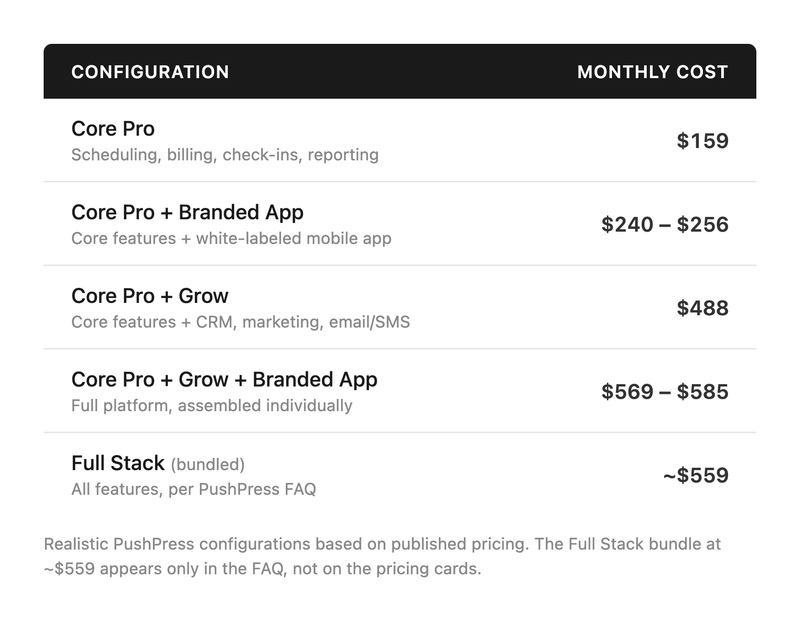
Grow is a $329-per-month add-on that includes a full CRM, automated marketing workflows, email and SMS campaigns, and a website builder. In practical terms, it's the feature set that transforms PushPress from a capable gym management tool — scheduling, billing, check-ins, the core operational stack — into something closer to an all-in-one operations and marketing platform. And once you add Grow to Core Pro, the total cost lands at $488 per month, which puts PushPress in the same price range as the premium tiers of vendors like Mindbody and Mariana Tek — companies that, notably, don't publish their prices at all.
That price range might help explain how Grow is positioned on the page — or, more accurately, how it isn't. Grow doesn't appear anywhere near the pricing cards. There's no add-on tile for it, no reference in the tier comparison, no call-out alongside Core Free, Core Pro, and Max. The only places Grow surfaces on the entire pricing page are two FAQ entries buried below the fold — one listing it as a $329-per-month product in a pricing breakdown, and another describing its CRM and marketing capabilities in response to "Does PushPress have built-in marketing tools?" If you visited the page, compared the tier cards, and left — which is exactly what most owners do during a side-by-side comparison — you would have no idea the product existed.
That FAQ section, incidentally, tells a noticeably different story than the pricing cards above it. It lists Core Free, Core Pro, Train, Grow, Branded App, and a Full Stack bundle at "~$559 per month." The Max tier — the one with its own dedicated pricing card at the top of the page — doesn't appear at all.
I think that's worth sitting with for a moment. The pricing cards present a three-tier model where Max is one of the plans a buyer is choosing between. The FAQ presents a modular model where Max doesn't exist and the meaningful configuration is Core Pro plus whichever add-ons fit your operation. These are two different product architectures described on the same page, and given that the FAQ is the section with specific dollar amounts for every add-on and a bundled package that doesn't appear anywhere on the pricing cards, my read is that the FAQ is the more complete picture. The cards are optimized for the screenshot comparison; the FAQ is written for the person who's already decided to look harder.
One detail on the Full Stack bundle: it's listed at "approximately" $559 per month, with a tilde doing real work. If you price Core Pro plus Grow plus the Branded App à la carte, you land somewhere between $569 and $585 depending on the app pricing tier, so the ~$559 presumably reflects a bundled discount. But the use of "approximately" for a subscription product is unusual — it's not the kind of flexibility you typically expect from a number that hits your credit card every month. It's a small thing, but it fits the broader pattern: the further you move from the pricing cards into the fine print, the more the numbers shift from firm to provisional.
One more note on Grow that's worth flagging here, though it warrants a fuller treatment in a future post: Grow runs as a separate platform with its own login and its own interface. PushPress's help documentation includes dedicated guides for navigating and using the Grow product, and the screenshots in those guides show a UI that's visually distinct from the core PushPress application. For an owner evaluating PushPress as an all-in-one solution, that integration boundary is an important operational detail — but the mechanics of how it works day to day is a bigger question than this pricing analysis can cover, so I'll come back to it.
What you're actually comparing
If you've stayed with me through the numbers, the practical point is this: PushPress at $159 per month and PushPress at $488 per month are not the same product. The pricing page lets you see the first number during a quick comparison, but the sales process is oriented around moving you toward the second. When you screenshot PushPress alongside Gymdesk and line up the published numbers — $159 against $100 or $150 — you're comparing PushPress's entry point against another vendor's most common operating tier. The products at those price points serve broadly similar functions, but the trajectory from there is very different.
I want to be clear that this isn't a problem unique to PushPress, and pointing it out as though it were would be dishonest. Pricing pages across this entire category are optimized to look competitive in the side-by-side screenshot comparison. Gymdesk, for instance, lists facility access control as a feature in its pricing tiers, but the actual implementation requires a third-party integration that carries a meaningful additional monthly cost — a detail that doesn't appear on the pricing page. The specifics vary by vendor, but the structural incentive is the same: the number on the pricing card is the number the vendor wants you to compare, not necessarily the number that will appear on your monthly statement. PushPress happens to have the widest gap between the two, which makes it the most useful example to study in detail — but it's an example of a category-wide pattern, not an outlier.
If you're evaluating PushPress specifically, the most useful thing you can do is decide which PushPress you're evaluating before you get on a sales call. Are you looking at Core Pro at $159 per month — a gym management tool that competes head to head with Gymdesk, GymMaster, and platforms in that range? Or are you looking at the full platform with Grow at $488-plus per month, which adds a CRM, marketing automation, and a feature set that puts it in a different competitive bracket entirely? Those are genuinely different decisions with different comparison sets, and being clear about which one you're making will save you time in both the evaluation and the conversation.
In my earlier post, I wrote that the way a vendor sells its software is almost always a compressed preview of what it's like to use it. PushPress's pricing page is a detailed case study in why that's true: a product that straddles two markets produces a pricing page that tells two stories, and the distance between them is where the real evaluation starts.