Gym Concept Spotlight: Iron 24's Staff-Optional Tradeoff

The phrase that keeps bothering me with Iron 24 is “staff-optional,” because it sounds cleaner than the operating model underneath it. If you run a gym, the appeal is obvious: fewer fixed shifts means fewer coverage problems, fewer front-desk handoffs, fewer manual signups, fewer awkward cancellation conversations, and fewer nights where the business depends on whoever happened to be scheduled at 8:45 p.m. A gym with less fixed labor is cheaper, but the more important point is that it feels easier to own.
The useful version of the idea is not that every independent gym should become a 24/7, app-first franchise; most should not, and many would probably weaken the thing their members value most if they tried. Iron 24 is worth studying because it forces a more useful question: which parts of a gym actually need a person, and which parts are only staffed because the underlying process is too messy to survive without one?
The Ownership Product
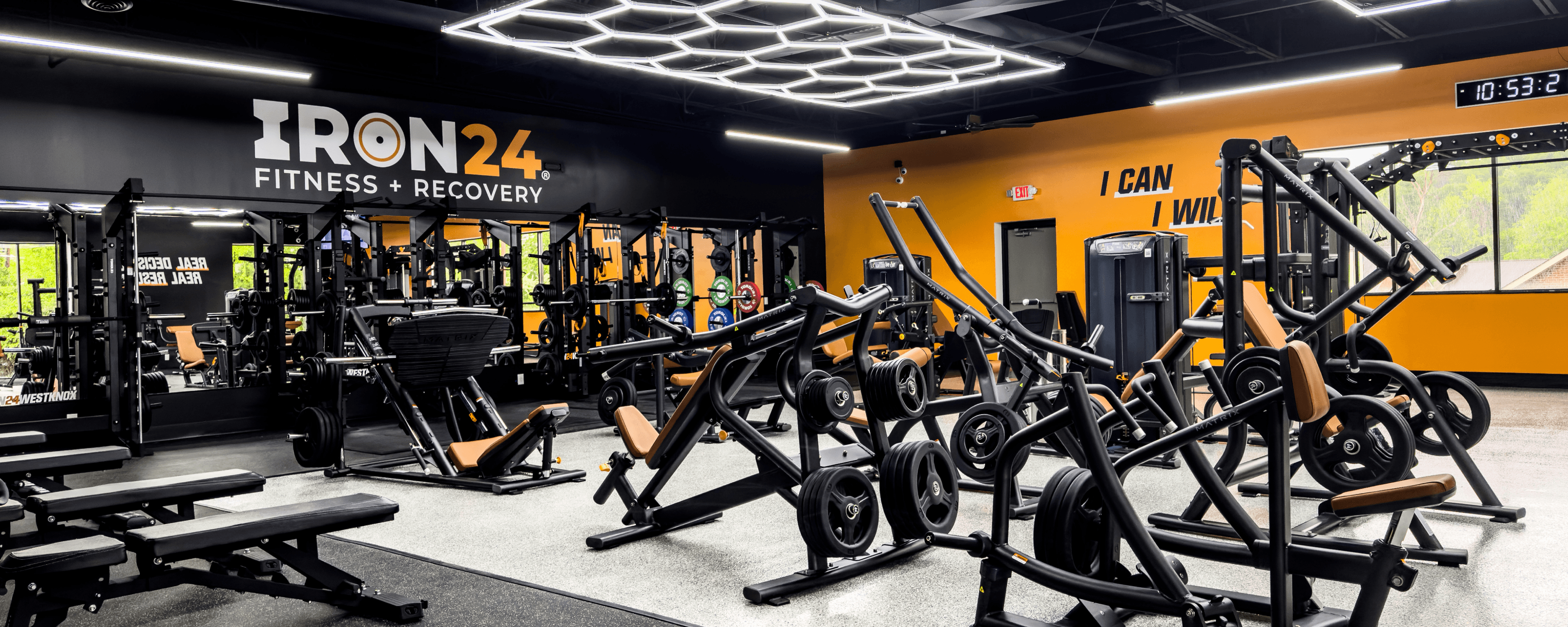
On the member side, Iron 24 is easy enough to place. It offers 24/7 access, digital membership, no-contract options, strength and cardio equipment, and a recovery layer that varies by location. The early corporate locations were 4,200 and 4,925 square feet, which is useful context: this is a compact access gym with enough recovery and service texture to feel more premium than a bare room full of equipment.
The owner-facing pitch is more revealing. The current franchise page describes Iron 24 as “a new way to own a gym,” while the brand vision is “to be the world’s easiest gym to own, join, and use.” That sentence collapses three separate frictions into one promise: joining should be easy for the member, using the gym should be easy once they are inside, and owning the gym should be easier than owning a traditional staffed facility.
That framing makes more sense once you remember where Iron 24 came from. The concept was launched by FranchiCzar, a franchise-software and franchise-development company, rather than by a legacy gym operator simply testing another format. I don’t think that origin is incidental. A traditional gym company might start with the member experience and then build operating systems around it; Iron 24 feels as if it started with the system and asked what a gym would look like if access control, payments, franchise support, and member management were treated as the core product.
The workout floor still matters, of course, but the real promise is that the gym can be made more ownable. The messy middle of running the business – signup friction, access control, billing updates, membership administration, tours, cancellations, support questions, local lead capture – is the target. Iron 24 is trying to compress that work into software and process before the absence of a person starts to show up somewhere else.
Software As The Front Desk
The cleanest way to read Iron 24 is to separate the administrative layer from the human-service layer. The administrative layer is the part of the gym that has historically been handled by people even when the job did not require much judgment: explaining the membership, entering payment details, issuing a key fob, changing a billing date, following up with a lead, answering a cancellation question, or acting as the general-purpose buffer between the business and the member.
Iron 24 tries to push much of that layer into the digital flow. Members can sign up online or in the app, use phone-based access, manage membership details, book appointments, track sessions, message coaches, and use the app for workouts, goals, nutrition, progress photos, body measurements, and wearable integration. The exact adoption probably varies by location, but the architecture is clear enough. The app is meant to be more than a key; it is meant to be the default interface for a large part of the business.
That changes the role of software inside the gym. In a conventional facility, software usually sits behind the staff: the member may download the app or receive a billing email, but a human still provides the path through confusion. Iron 24 asks software to sit in front of the staff, which is appealing for the same reason it is risky. The routine interactions can become more consistent and less labor-intensive, but only if the underlying flows are clear enough that members do not need someone standing nearby to translate them.
An operator can see the attraction immediately. Front-desk labor is coverage, training, turnover, inconsistent execution, and the daily management surface of making sure the person representing the business actually understands the business. Even good employees create variability, because a human process has to be managed every time it runs. Moving routine interactions into self-service can remove a category of operational drag that is easy to underestimate until you have lived inside it.
The tradeoff is that self-service has to be genuinely better than the staffed version at the work it replaces. A confusing billing flow, a clumsy cancellation path, or an unreliable app login turns the missing front desk into a trust problem.
The Humans Are Still There
This is where the early “zero-staff” framing starts to break down. Iron 24’s current public materials still point to a business with humans in it, just not humans sitting inside every routine transaction. The active location records I reviewed all showed personal training availability, and the location pages repeatedly mention coaching or personal training as part of the offer. The app reinforces the same point: training plans, coach messaging, appointment booking, session balances, and progress tracking belong to a gym that expects people to play a role, even if that role is scheduled, local, or owner-driven rather than always present.
The local sites make the point more clearly than the corporate tagline. Pittsburgh, for example, presents itself less like a pure self-serve access gym and more like a private training and recovery environment, with capped membership, a recovery suite, testimonials emphasizing privacy and support, and a personal-training-heavy pitch. Knoxville has its own local pricing and recovery page, with fitness-only and fitness-plus-recovery options laid out in detail. These are not just minor variations on national copy; they suggest a model where the franchisor supplies the shell, while the local operator still has to translate the offer into a market.
My read is that Iron 24 lowers fixed floor labor while leaving plenty of human work in the system. Coaching, recovery education, local sales, facility upkeep, lead follow-up, and trust-building still have to happen somewhere. In one location that may mean an owner who is unusually present; in another it may mean a trainer-led local team. The important distinction is that the model removes the assumption that a person must sit inside every routine transaction, not the need for people altogether.
That makes the lesson more specific than “automate your gym,” which is usually too vague to be useful. A better version is to sort the work first: administrative, relational, and judgment-heavy. Administrative work is the obvious automation target, but only when the process underneath is clean enough that a member can complete it without a human interpreter.
The Economics Explain The Pressure
The financial details are useful mainly because they explain why the model has to be built this way. A 4,000-to-5,000-square-foot access gym has less room to spread fixed labor across thousands of members than a large-format club, and less margin for casual complexity. For a location like this to work, the business has to be disciplined about which costs become permanent.
The 2024 franchise disclosure document, or FDD, gives a small window into that pressure. It disclosed average gross revenue and active subscriptions by month-open for the seven outlets then in the data set, which included five company-owned outlets and two franchised outlets at the end of 2023. The sample gets very small in later months, so I would not treat the numbers as mature unit economics, but the ramp still explains the operating logic: Month 6 averaged $6,600.75 in gross revenue on 150 active subscriptions, Month 9 averaged $8,314 on 195 subscriptions, and Month 15, based on one location, showed $13,073 on 337 subscriptions.
Those numbers are a reminder that “staff-optional” has to be structural rather than cosmetic. At that revenue scale, especially before a location matures, a conventional front desk would be hard to carry for long. Digital onboarding, reliable access, self-service billing, local lead capture, and scheduled human time are part of the cost structure, not nice-to-have tech features layered on top of a normal gym.
Where The Tradeoff Shows Up
The public signals around Iron 24 make more sense through this lens. The national Instagram account has been quiet for more than a year, which is worth noticing, but I would not read that alone as proof that the business is struggling. The footprint is still real, the official location data showed 19 open locations and 3 coming soon when I reviewed it, the app is still being updated, and several locations have their own social accounts or local sites. A corporate social channel going quiet can mean momentum has faded, but it can also mean acquisition has shifted toward local operators, paid search, app install flows, or market-specific landing pages.
Either way, the quiet national account points back to the same dependency. If the model leans on local owner execution, then local marketing matters more than national brand posture. The franchisor can supply identity, software, playbooks, and operating assumptions, but a gym still has to create demand in a specific neighborhood. A staff-optional facility may need fewer fixed hours inside the building, while needing more disciplined trust-building outside of it.
The app reviews raise the member-side version of the same issue. The App Store page shows recent updates, which is a good sign, but the public rating is weak and several complaints mention login, cancellation, billing, or difficulty getting through the app-driven flow. The sample is too small to diagnose the brand, but it is still a useful warning because the app is not a side feature here. In this model, the work that used to happen at the front desk reappears in the product experience, which means product frustration quickly becomes operational frustration.
This is the point independent owners should sit with. Staff can be inefficient, but they also absorb ambiguity: they notice confusion, translate policies into normal language, and recover from edge cases the system did not anticipate. Once that layer is reduced, the process itself has to carry more of the service experience, which means the software can be imperfect, but it has to be much clearer than the process it is replacing.
What To Copy, Ignore, And Watch
I would not copy Iron 24 as a full model unless your business is trying to solve the same problem. Many independent gyms are intentionally human-heavy, and their staff presence, coaching culture, and local relationships are part of what members are buying. For those gyms, the better goal is to stop wasting staff on work that does not benefit from a human being.
What I would copy from Iron 24 is the discipline of asking where operational drag actually lives. Joining should be simple, access should be reliable, billing should be understandable, scheduling should not require a pile of texts, and a new member should not need a tour just to understand what they bought. Cancellation should be clear enough that the member may dislike the policy, but they should not feel trapped inside a process nobody wants to explain.
What I would ignore is the fantasy version of automation, the one where software makes a gym easier to run simply because a vendor or franchisor says it does. A bad onboarding process delivered by an employee is still bad, but at least the employee can improvise. A bad onboarding process delivered by software becomes repeatable friction, a cleaner-looking way to disappoint people while calling it leverage.
The thing to watch is whether Iron 24 can keep the local-owner layer strong enough to compensate for the reduced staff layer. Pittsburgh may be more instructive than the corporate tagline because it shows one version of the model becoming more local, more training-forward, and more trust-heavy. Other locations may stay closer to the access-gym template. That variation is not automatically a weakness, but it does raise the core franchise question: can the system standardize the parts that need to be standardized while leaving enough room for local operators to do the human work the app cannot do?
That is why Iron 24 is more interesting as an operating question than as a category label. “Staff-optional” means the gym has made a bet about where labor should live. Some work belongs in software because members should not have to wait for a person to perform a simple administrative task. Some belongs with the local owner because a neighborhood still has to be sold, served, and understood. Some belongs with trainers or staff because trust, judgment, and accountability still matter when the door unlocks with a phone.
The useful version of the Iron 24 experiment is whether a gym can move enough routine work out of fixed labor to make ownership simpler without letting the missing human layer reappear as confusion, mistrust, or churn. That is a much more interesting tradeoff than the phrase “zero-staff gym” suggests, and it is the one independent operators should be paying attention to.